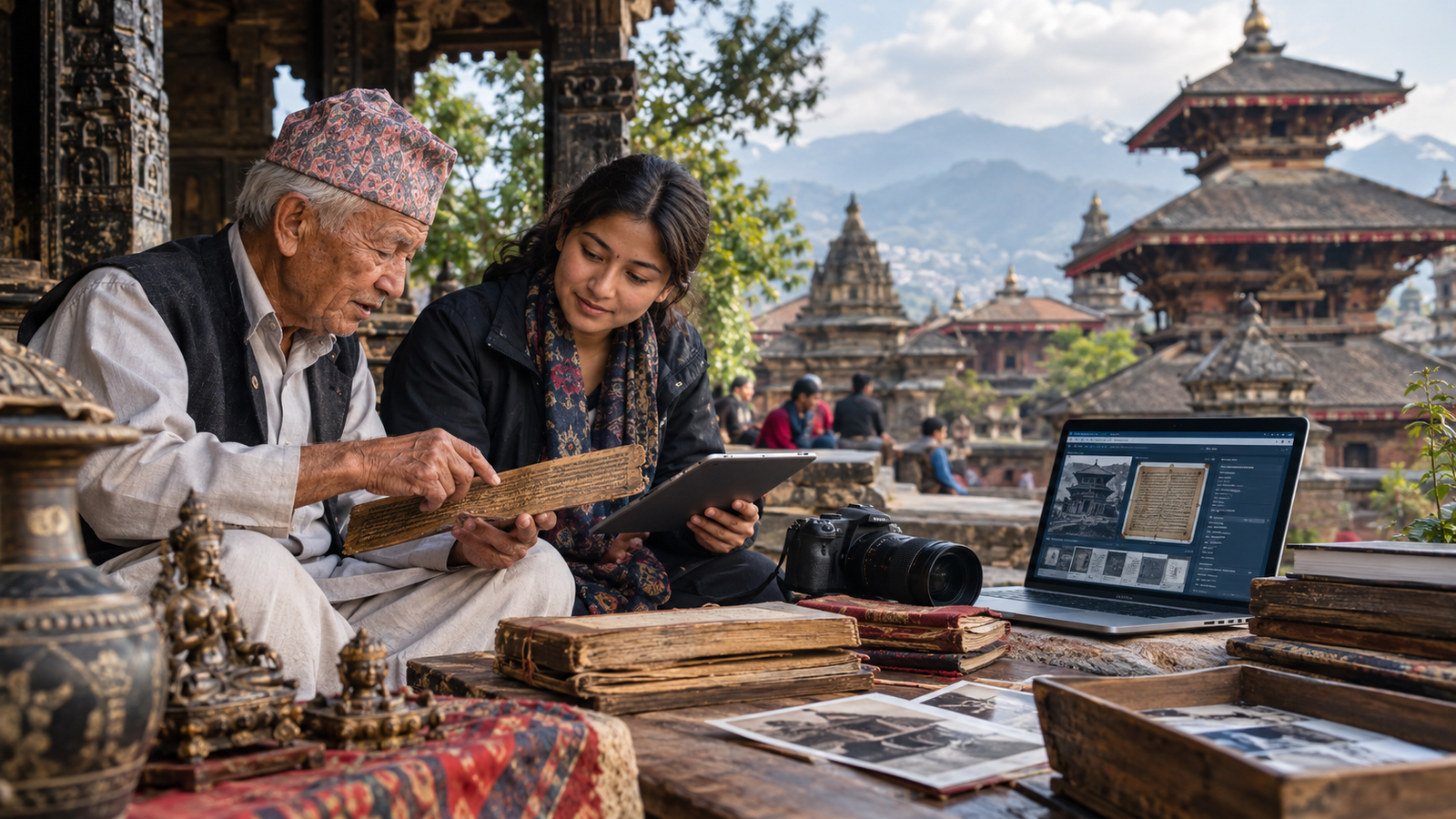

Nepal is often described through its mountains, temples, festivals, historic cities and diverse communities. But Nepal’s heritage is much larger than the monuments that appear in photographs or the sites listed in official registers. Heritage also lives in the stories grandparents tell, the languages spoken at home, the rituals performed by communities, traditional craftsmanship, local knowledge, music, food traditions, festivals, religious practices, manuscripts, photographs, family records and memories of places that may already be changing. Some of this heritage is visible. Much of it is not. And some of it exists only in the memories and practices of people. This is where digital heritage and heritage digitization become increasingly important.

A photograph of an old building, a scanned manuscript, a recorded oral history, a digital museum catalogue, a three-dimensional model of a monument or an online archive can help create a record that may remain accessible even when the original object, structure or context is threatened. But there is an important distinction Nepal needs to keep in mind:
Digitizing heritage is not the same as preserving heritage.
A digital photograph cannot replace a historic building. A video of a traditional ceremony cannot replace the community that performs it. A scanned manuscript cannot replace the knowledge of the people who understand its language, context and meaning. Digital technology is a tool for safeguarding heritage—not heritage itself. For Nepal, therefore, the real question is not simply how much heritage can be digitized. The deeper question is: How can digital technology help communities retain, understand, transmit and responsibly share their own heritage? What Do We Mean by Digital Heritage? The term digital heritage can be understood in two connected ways. The first is heritage that is born digital. This includes websites, digital photographs, digital recordings, online publications, born-digital archives, digital artworks and other cultural materials that may never have existed in physical form. The second is heritage that is digitized. Digitization means creating digital representations of existing physical or cultural materials. A manuscript can be scanned. An old photograph can be digitally preserved. A museum object can be photographed or documented in three dimensions. An oral history can be recorded as audio or video. A traditional song can be documented with appropriate permission. UNESCO has recognized the importance of preserving digital heritage and maintaining its accessibility over time. Digital heritage can cross geographical and cultural boundaries and can provide communities with new ways to represent and share their cultural knowledge. For a country as culturally diverse as Nepal, this potential is particularly significant. Digital platforms can connect a local heritage site in a remote municipality with students, researchers and communities elsewhere in Nepal—or with interested audiences around the world. But accessibility must come with responsibility. Not everything should automatically be placed online. Some cultural knowledge may have customary restrictions. Some religious practices may be sensitive. Some community knowledge may require permission before recording or publication. UNESCO's 2003 Convention recognizes the need to respect customary practices governing access to particular aspects of intangible cultural heritage. Therefore, digitization should begin with listening, not simply with a camera or scanner.

Nepal's Heritage Is Both Tangible and Intangible When people hear the phrase "cultural heritage," they often imagine monuments. Nepal certainly has an extraordinary architectural heritage. The Kathmandu Valley, for example, was inscribed on the UNESCO World Heritage List in 1979 and consists of seven monument zones, including the Durbar Squares of Kathmandu, Patan and Bhaktapur and the religious ensembles of Swayambhu, Boudhanath, Pashupati and Changu Narayan. But heritage is not limited to architecture. Intangible cultural heritage includes oral traditions and expressions, performing arts, social practices and rituals, knowledge concerning nature and the universe, and traditional craftsmanship. This distinction matters enormously in Nepal. A traditional building may survive while the knowledge required to maintain it disappears. A festival may continue while younger generations gradually lose knowledge of its meanings. A traditional craft may remain visible while fewer people possess the skills to make it. A language may still have speakers today while its oral histories and vocabulary become increasingly difficult to transmit to future generations. In other words:
The physical survival of heritage does not automatically guarantee the survival of cultural knowledge.
Digital documentation can help address part of this problem. Why Digitization Matters for Nepal Nepal's geography, history and exposure to disasters make documentation particularly important. The 2015 earthquake demonstrated how quickly cultural heritage can be damaged or lost. The experience also highlighted the importance of documentation, community engagement, maintenance and preparedness in protecting cultural heritage. Digital documentation cannot prevent an earthquake, flood, fire or other disaster. But it can create records that may help future generations understand what existed before a disaster and can support research, education, conservation planning and recovery. The value of digitization is therefore not only technological. It is historical. It is educational. It is social. And, when properly managed, it can also be intergenerational. Digital Documentation Can Preserve More Than Objects One of the most important opportunities for Nepal is to move beyond photographing monuments. A meaningful digital heritage programme could document:

Oral histories
Traditional songs and music
Local languages and vocabulary
Festivals and rituals
Traditional crafts
Indigenous and local knowledge
Historic photographs
Manuscripts
Inscriptions
Architecture
Archaeological objects
Museum collections
Traditional agricultural practices
Memories associated with historic places
Traditional recipes and food knowledge
Stories connected to landscapes and settlements
Biographies of cultural practitioners
Disappearing techniques and skills
This is particularly important because intangible heritage is living heritage. It is continuously recreated by communities and transmitted from generation to generation. Safeguarding therefore involves documentation and research, but also transmission, education and revitalization. That means an archive should not simply answer:
"What did this community do?"
It should also help future generations understand:
"Who practiced it, why did they practice it, what did it mean, and how can the knowledge continue?"
The Community Must Be at the Centre This may be the most important principle in heritage digitization. A community should not become merely the subject of documentation. It should become a participant in the documentation process. UNESCO's 2003 Convention places strong emphasis on the participation of communities, groups and individuals who create, maintain and transmit intangible cultural heritage. Article 15 specifically calls for their active involvement in safeguarding activities. This principle has direct relevance to Nepal. Suppose a researcher travels to a village and records a traditional ceremony. The researcher may have technical equipment. The researcher may know how to record high-quality audio and video. But the community may know things that the camera cannot capture:
Why the ceremony is performed
Which parts are sacred
Who is permitted to participate
Which songs have particular meanings
Which objects have ritual importance
How the tradition has changed
Which versions are considered authentic by practitioners
What information should remain private
Without community knowledge, the resulting archive may be technically impressive but culturally incomplete. From "Documentation of Communities" to "Documentation With Communities" There is a significant difference between these two approaches. Documentation of Communities An outsider arrives, records information, creates an archive and leaves. Documentation With Communities Researchers, cultural professionals, local institutions, young people and community members work together to identify what should be documented, how it should be documented, how it should be described, who can access it and how the material should be used. The second approach is much closer to the participatory philosophy reflected in UNESCO's framework. Nepal is already moving in this direction. In 2026, UNESCO and Nepal's Ministry of Culture, Tourism and Civil Aviation launched a national initiative to develop an inventory of intangible cultural heritage covering all seven provinces. The initiative focuses on community-based inventorying and includes representatives from Indigenous communities.

It also emphasizes capacity building so that communities themselves can participate in documenting their heritage. This is important because a national heritage archive cannot be sustainable if local communities remain passive recipients of documentation. Nepal's Current Challenge: A Rich Heritage With Documentation Gaps Nepal possesses extraordinary cultural diversity, but much of its intangible heritage remains insufficiently documented. UNESCO's recent reporting on Nepal's national inventory initiative identifies documentation gaps and weakening intergenerational transmission of knowledge as important challenges, alongside migration, modernization and social change. This creates a race against time. When an elderly storyteller dies, an oral tradition may disappear with that person. When a skilled craftsperson stops practicing, a technique may become difficult to recover. When younger generations move away from their ancestral communities, everyday knowledge may no longer be transmitted in the same way. Migration itself is not something that should simply be described as a threat. Migration is part of contemporary Nepali society and can create new cultural connections as well. But it can change the conditions through which heritage is traditionally transmitted. This is why documentation must be accompanied by education and active transmission. Digitization Is Not Preservation by Itself This distinction deserves emphasis. Imagine a municipality scans 10,000 historical photographs and uploads them to a website. That sounds like a successful digitization project. But what happens if:
The files are stored in only one location?
Nobody maintains the website?
File formats become obsolete?
Metadata is missing?
Photographs have no dates or provenance?
Names of people and places are incorrect?
The archive has no backup?
The community cannot access it?
Copyright or consent was never clarified?
The server disappears after a few years?
The collection may be "digital" without being genuinely preserved. True digital preservation requires planning. It requires reliable storage, multiple backups, appropriate metadata, documentation standards, file management, access policies and long-term institutional responsibility. Recent work on the digitization of Newari manuscripts in Nepal illustrates this issue. UNESCO has reported that historic manuscripts face environmental and conservation risks, while digitization efforts have also faced accessibility and standards challenges. The lesson is clear:
Scanning is the beginning of digital preservation, not the end.
The Importance of Metadata A digital photograph without context may have limited historical value. Consider two files: IMG_2048.jpg and Bhaktapur_Traditional_Woodcarving_Community_1987.jpg The second already provides more information. But professional heritage documentation needs much more. Metadata may include:
Title
Creator
Date
Location
Language
Community
Cultural context
Description
Source
Rights information
Photographer or recorder
Recording information
Related objects
Preservation information
Keywords
Without metadata, a digital archive can gradually become a digital warehouse. With good metadata, it can become a research resource. For Nepal, multilingual metadata is particularly important. A heritage record should not necessarily exist only in English. Nepali and relevant local or Indigenous languages can make digital collections more meaningful to the communities whose heritage is being documented. The Language Problem in Digital Heritage Nepal's cultural diversity is closely connected with linguistic diversity. Nepal has more than 125 ethnic groups and more than 123 languages, according to UNESCO's recent reporting on its national intangible cultural heritage inventory initiative. This presents both an opportunity and a challenge. A digital heritage archive can help preserve recordings and documentation of languages. But if the archive only uses a dominant language, important cultural meanings can be lost. For example, a traditional term may have no exact equivalent in English. A ritual may have a name whose meaning depends on local history. An oral story may contain expressions whose cultural significance disappears when translated too literally. Therefore, digital heritage should preserve the original language, while translations can be provided where appropriate. Translation should expand access—not erase linguistic identity. The Digital Divide Is Also a Heritage Problem It is easy to imagine that once heritage is placed online, everyone can access it. Reality is more complicated. Nepal has differences in access to:
Reliable internet
Digital devices
Electricity
Digital literacy
Technical skills
Institutional resources
Professional archival infrastructure
A heritage digitization programme designed only for urban audiences may unintentionally exclude the communities whose heritage it claims to preserve. This is why digital heritage needs both online and offline strategies. Community archives, local museums, schools, libraries and cultural centres can become important access points. Digital heritage should reach communities—not merely expect communities to reach a website. Who Owns Digitized Heritage? This is one of the most difficult questions. Suppose someone photographs a traditional ritual. Who owns the photograph? The photographer? The institution that funded the project? The person performing the ritual? The community? What happens when the image is later used commercially? What if a sacred object is photographed without permission? What if an oral history is published without explaining how it will be used? Technology can make copying extremely easy. That makes ethical responsibility even more important. Digitization projects should therefore consider: Consent, attribution, intellectual property, privacy, customary access, cultural sensitivity and community rights. UNESCO's intangible cultural heritage framework emphasizes respect for customary practices concerning access to particular aspects of intangible cultural heritage. The principle should be simple:
If heritage belongs to a living community, the community should have a meaningful voice in how its digital representation is created and used.
The Risk of Turning Culture Into "Content" There is another danger in the age of social media. Heritage can easily become content. A traditional dance becomes a short video. A centuries-old building becomes an Instagram photograph. A ritual becomes a tourism attraction. A traditional craft becomes a commercial aesthetic. Digital visibility can be valuable, but visibility should not become the only measure of heritage value. A practice does not become important because it receives thousands of views. And a tradition does not lose its value because it is not popular online. Heritage work should therefore avoid reducing culture to photographs, reels, tourism promotions or viral posts.
Culture is lived before it is uploaded.
Social Media: Opportunity and Risk Social media has nevertheless created new opportunities. Young Nepalis can discover local traditions through:
Short documentaries
Podcasts
Digital exhibitions
Photographs
Online museums
Educational videos
Digital storytelling
Interactive maps
Interviews with cultural practitioners
A young person living abroad may be able to hear a grandparent's village dialect through an online archive. A student in Kathmandu may learn about a traditional craft from another province. A researcher may discover a previously difficult-to-access manuscript collection. A local museum may reach audiences far beyond its physical building. These are genuine benefits. But social media algorithms tend to reward novelty, emotion and visual appeal. Heritage institutions therefore need to balance engagement with accuracy. A popular post containing incorrect historical information can spread misinformation much faster than a carefully researched correction. Digital Heritage and Museums Museums can play a major role in Nepal's digital heritage ecosystem. A museum's digital presence can include:

Collection databases
Object photographs
Oral histories
Virtual exhibitions
Educational resources
Digitized catalogues
Archival documents
Historical timelines
Interactive maps
Video interviews
Three-dimensional models
Research publications
But a museum website should not become merely an online gallery. The goal should be to provide context. A digital object record should help visitors understand: What is it? Where did it come from? Who made it? How was it used? What community is associated with it? Why is it significant? What is known—and what remains uncertain? This is how digital technology can turn information into learning. The Role of Young People Young people should not be treated only as audiences for heritage. They can become documenters, researchers, storytellers, designers, developers, archivists and cultural advocates. A young person with a smartphone can record an elder explaining a traditional farming technique. A student can create a digital map of local heritage places. A developer can build an online cultural archive. A photography student can document traditional architecture. A language student can help transcribe oral histories. A school can create a community heritage project. Universities can collaborate with municipalities and museums to build local digital collections. This is particularly relevant because Nepal's current national intangible cultural heritage inventory initiative emphasizes youth participation and community capacity building. The future of heritage preservation should not be separated from the digital generation. Local Governments Have an Important Responsibility Heritage preservation is often discussed as though it belongs exclusively to national institutions. That is not realistic. Local governments are much closer to many heritage resources and communities. Municipalities can support:
Local heritage inventories
Digital archives
Museums
Cultural centres
Documentation projects
Oral-history programmes
School heritage initiatives
Local-language resources
Conservation awareness
They can also help identify heritage that may never appear in national databases. A small village shrine, historic water spout, traditional house, community festival or oral tradition may have enormous local significance without being internationally famous. Digital technology provides an opportunity to document these smaller stories. Nepal Needs a Network, Not Isolated Digital Projects One of the long-term challenges is fragmentation. Different organizations may independently photograph the same heritage site. Another organization may create a separate database. A museum may maintain its own collection system. A researcher may keep important recordings on a personal hard drive. A municipality may create a website that disappears when the project ends. A community organization may maintain valuable photographs without a preservation plan. The result can be scattered knowledge. Nepal would benefit from stronger coordination among:
Government heritage agencies
Museums
Archives
Universities
Municipalities
Libraries
Community organizations
Indigenous and local communities
Researchers
Technology professionals
Photographers and filmmakers
Cultural practitioners
The objective should not necessarily be one enormous website containing everything. The more useful goal is a connected heritage ecosystem in which collections can remain locally meaningful while following compatible documentation and preservation principles. Disaster Risk Makes Digital Documentation More Urgent Nepal's heritage faces risks from natural disasters, urban development, environmental change and social transformation. The Kathmandu Valley provides a clear example of the complexity involved in protecting heritage within a rapidly changing urban environment. Digital documentation cannot solve these structural problems. But it can create an evidence base. Detailed records can support:
Conservation planning
Research
Education
Emergency response
Reconstruction documentation
Public awareness
Historical comparison
This makes digital documentation particularly valuable before a crisis happens—not only after one. Climate Change Adds Another Layer Heritage preservation can no longer be discussed only in terms of earthquakes and urbanization. Climate-related events can also affect cultural landscapes and communities. The experience of Thame in the Everest region illustrates this relationship. Following the 2024 glacial lake outburst flood, UNESCO worked with the Sherpa community to document living heritage affected by the disaster, including cultural practices and knowledge systems. This demonstrates an important point:
When a disaster affects a community, it can damage both physical heritage and the social environment in which living heritage is practiced.
A heritage strategy that documents only buildings may therefore miss an essential part of cultural resilience. The Five Major Challenges for Digital Heritage in Nepal 1. Lack of Systematic Documentation A large amount of cultural knowledge remains undocumented or scattered across private collections, communities and institutions. Nepal's current national inventory initiative itself recognizes the need to address documentation gaps. 2. Limited Technical and Institutional Capacity Digitization requires more than cameras and scanners. It requires people who understand:
Archival standards
Metadata
Digital preservation
Database management
Conservation
Copyright
Cultural ethics
Audiovisual recording
Cybersecurity
Long-term storage
3. Community Participation Documentation without community involvement can produce incomplete or inappropriate records. The people who maintain heritage must have a meaningful role in deciding how it is documented and represented. 4. Long-Term Digital Preservation Uploading files is not the same as preserving them. Digital collections require backups, maintenance, documentation, migration strategies and institutional responsibility. 5. Access Versus Cultural Sensitivity Not everything should necessarily be publicly accessible. Heritage platforms must balance openness with privacy, customary restrictions, consent and cultural sensitivity. What Should Nepal Do? There is no single technological solution. A sustainable approach could be built around several principles. Document Before It Disappears Prioritize heritage that faces immediate risk of loss, including endangered languages, oral histories, traditional skills and vulnerable documentary collections. Document With Communities Community members should participate in identification, recording, interpretation and decisions about access. Preserve Original Context Do not store only an image or video. Record the history, location, language, people, meaning and circumstances associated with it. Build Sustainable Archives Use reliable storage, backups, metadata and preservation planning rather than temporary project folders. Support Local Institutions Municipalities, schools, museums, libraries and community organizations need practical tools and training. Encourage Young People's Participation Heritage preservation should connect traditional knowledge with contemporary digital skills. Use Local Languages Digital heritage should represent Nepal's linguistic diversity rather than presenting everything through a single language. Respect Cultural Rights Consent, attribution, customary access and community expectations should be considered before publication. Connect Digital Preservation With Physical Conservation A digital record should support—not replace—the protection of physical heritage. Make Heritage Useful Digital archives should support education, research, community identity and responsible cultural engagement rather than simply collecting files. What Can an Individual Do? Heritage preservation does not belong only to governments and international organizations. An ordinary person can contribute. You can:
Interview an older family member about local history.
Photograph historic places responsibly.
Record traditional stories with permission.
Document traditional skills.
Identify old photographs.
Preserve family documents.
Learn the history of your community.
Support local museums.
Volunteer with cultural organizations.
Teach younger people about local traditions.
Share reliable heritage information online.
Correct misinformation respectfully.
Even a simple recording can become historically valuable decades later. But documentation should always be undertaken respectfully, especially when recording people, rituals or culturally sensitive knowledge. Digital Heritage Should Strengthen Cultural Identity, Not Replace It The ultimate purpose of heritage preservation is not to create the largest database. It is to ensure that people can continue to understand their history and cultural identity. A digital archive can preserve a photograph. A recording can preserve a voice. A scan can preserve the appearance of a manuscript. A database can preserve information about an object. But only people and communities can keep living heritage meaningful. UNESCO's framework is important here because safeguarding intangible heritage is not about freezing traditions in an unchanging form. Living heritage continues to evolve, and safeguarding focuses on its viability, transmission and continued relevance to the communities that recognize it. That is particularly relevant to Nepal. Nepali culture has never been completely static. Traditions have changed through migration, trade, religion, technology, education and contact between communities. Preservation should therefore not mean putting culture behind glass. It should mean helping communities carry knowledge forward. From Digital Archives to Living Heritage The strongest digital heritage project is not necessarily the one with the most files. It is the one that creates a connection between past, present and future. Imagine a digital archive where a student can listen to an elder explaining a traditional festival. Imagine a museum visitor scanning a QR code and hearing the community's own explanation of an object. Imagine a researcher accessing properly documented manuscripts. Imagine a local school using oral histories in history lessons. Imagine a young person learning a traditional craft from a digital tutorial created by an experienced practitioner. Imagine a municipality having a reliable digital record of its historic buildings before disaster strikes. These are not merely technology projects. They are cultural projects. A Shared Responsibility The responsibility for Nepal's heritage cannot rest on one institution. Government agencies have responsibilities for policy, protection, coordination and resources. Museums and archives have responsibilities for professional documentation and preservation. Universities and researchers have responsibilities for research and knowledge production. Technology professionals have responsibilities for building sustainable and accessible systems. Media organizations have responsibilities for accurate cultural storytelling. Schools have responsibilities for education. Local governments have responsibilities for local heritage. Communities and cultural practitioners have an essential role because they are among the people who create, maintain and transmit living heritage. And individuals have a role too. The most important principle is that these responsibilities should reinforce one another rather than operate separately. Conclusion: Nepal Must Preserve the Memory Behind the Monument Nepal's heritage is not only something we inherit from the past. It is something we continuously create, practice, interpret and transmit. The temple is heritage. The manuscript is heritage. The traditional house is heritage. But so is the knowledge of how that house was built. The festival is heritage. But so is the story that explains why the festival exists. The traditional instrument is heritage. But so is the skill required to make and play it. The language is heritage. And so are the stories carried through that language. Digital technology gives Nepal a remarkable opportunity to document these layers of cultural memory and make them available to future generations. But digitization should never become an excuse to neglect the physical protection of heritage or the communities that give heritage its meaning. A scanned manuscript needs an archive. An archive needs responsible management. A recorded tradition needs its community. A digital museum needs accurate information. And a heritage database needs people who will continue to care for it. The future of Nepal's heritage will therefore not be secured by technology alone. It will be secured when technology, communities, cultural practitioners, institutions, researchers, governments and younger generations work together. The goal should not be to put Nepal's culture permanently into a digital box. The goal should be to use digital technology so that more people can remember, understand, respect, learn from and continue the cultural knowledge that connects generations. Because ultimately, the most successful digital heritage project is not the one that merely preserves the past.
It is the one that helps the future remember where it came from.
Frequently Asked Questions What is digital heritage in Nepal? Digital heritage in Nepal refers to cultural materials and knowledge that are created digitally or converted into digital formats for documentation, preservation, research, education and access. This can include digitized manuscripts, photographs, museum objects, oral histories, traditional music, architectural documentation, digital archives and other cultural records. Why is heritage digitization important in Nepal? Heritage digitization can help document vulnerable cultural materials and knowledge, improve access for researchers and learners, support education and create records that may remain useful after disasters or physical deterioration. However, digitization should complement rather than replace physical conservation and community-based safeguarding. How can communities participate in heritage digitization? Communities can help identify what should be documented, provide historical context, participate in recording and interpretation, validate information, determine appropriate access and help transmit knowledge to younger generations. UNESCO's 2003 Convention places particular emphasis on active community participation in safeguarding intangible cultural heritage. What are the main challenges of digital heritage preservation in Nepal? Major challenges include incomplete documentation, limited technical capacity, fragmented collections, inadequate long-term digital preservation, metadata gaps, access and connectivity issues, copyright and consent concerns, cultural sensitivity and the need for stronger community participation. Can digitization replace physical heritage conservation? No. Digital documentation can create an important record, but it cannot replace the physical conservation of monuments, manuscripts, objects or cultural spaces, nor can a digital recording substitute for the living communities and practitioners who transmit intangible heritage. Why are young people important in heritage preservation? Young people can connect traditional knowledge with contemporary digital tools. They can participate in oral-history projects, photography, audiovisual documentation, digital archives, mapping, museum technology, research and educational projects. Nepal's current national intangible cultural heritage inventory initiative also emphasizes youth capacity building and participation.