
Building a Museum Website in Nepal: A Complete Guide to Digitally Preserving Heritage and Cultural Assets
There is a particular kind of loss that happens quietly. It doesn't make headlines the way a collapsed temple or a stolen idol does. It's the loss of context the story behind an object that only one elderly caretaker still remembers, the inscription on a manuscript that no one has translated in forty years, the oral history that exists nowhere but in a single person's memory. Nepal's museums and heritage institutions sit on top of an extraordinary amount of this kind of fragile knowledge, and most of it has never been photographed, catalogued, or written down in a form anyone outside the building could ever access.
A website will not save a temple from an earthquake. But a well-built one can make sure that even if the physical object is lost, what it was its form, its history, its meaning to the people who made it survives. That is the real purpose of a museum website in Nepal today. Not a digital brochure. Not a gallery of pretty photos. An actual second copy of the institution's memory, built to outlast the building it describes.
This guide walks through what that actually takes from the first conversation with a museum director to the technical architecture that keeps the data alive for decades.

Why Digital Preservation Is Urgent for Nepal Specifically
Every country has a case for digitizing its heritage. Nepal's case is more urgent than most, for reasons that are specific to its geography, history, and the current state of its institutions.
Seismic risk is not theoretical here. The 2015 Gorkha earthquake damaged or destroyed hundreds of heritage structures across the Kathmandu Valley, including sections of Durbar Squares that had stood for centuries. Reconstruction has restored much of the physical fabric, but original craftsmanship, materials, and in some cases entire artifacts were lost permanently. A digital record made before a disaster is often the only accurate reference reconstruction teams have to work from afterward.
Urbanization is quietly erasing intangible heritage. As younger generations move to cities or abroad for work, traditional skills mask carving, thangka painting, specific musical forms, ritual practices tied to particular localities are passed down to fewer and fewer people. Unlike a stone monument, a skill or a ritual leaves no ruin behind when it disappears. It simply stops.
Institutional capacity is limited. Many of Nepal's museums, especially community and regional ones, operate with small staff, minimal budgets, and no dedicated IT support. Collections are often catalogued on paper, in registers that exist as a single physical copy, vulnerable to fire, flood, insects, or simple loss.
Climate change adds a newer threat. Increasingly erratic monsoon patterns and flooding put low-lying archives and storage facilities at risk in ways that weren't a major concern a generation ago.
Put together, this means a heritage website in Nepal isn't a marketing nice-to-have. It's closer to a backup system for a country's memory.
What "Digitizing a Museum" Actually Means
The phrase gets used loosely, so it's worth being precise before getting into architecture. Digitization happens at several distinct levels, and a serious project usually touches all of them:
Documentation is the foundation high-quality photographs, measurements, condition notes, and provenance information for every object, recorded in a structured, searchable format rather than scattered across word documents and paper ledgers.
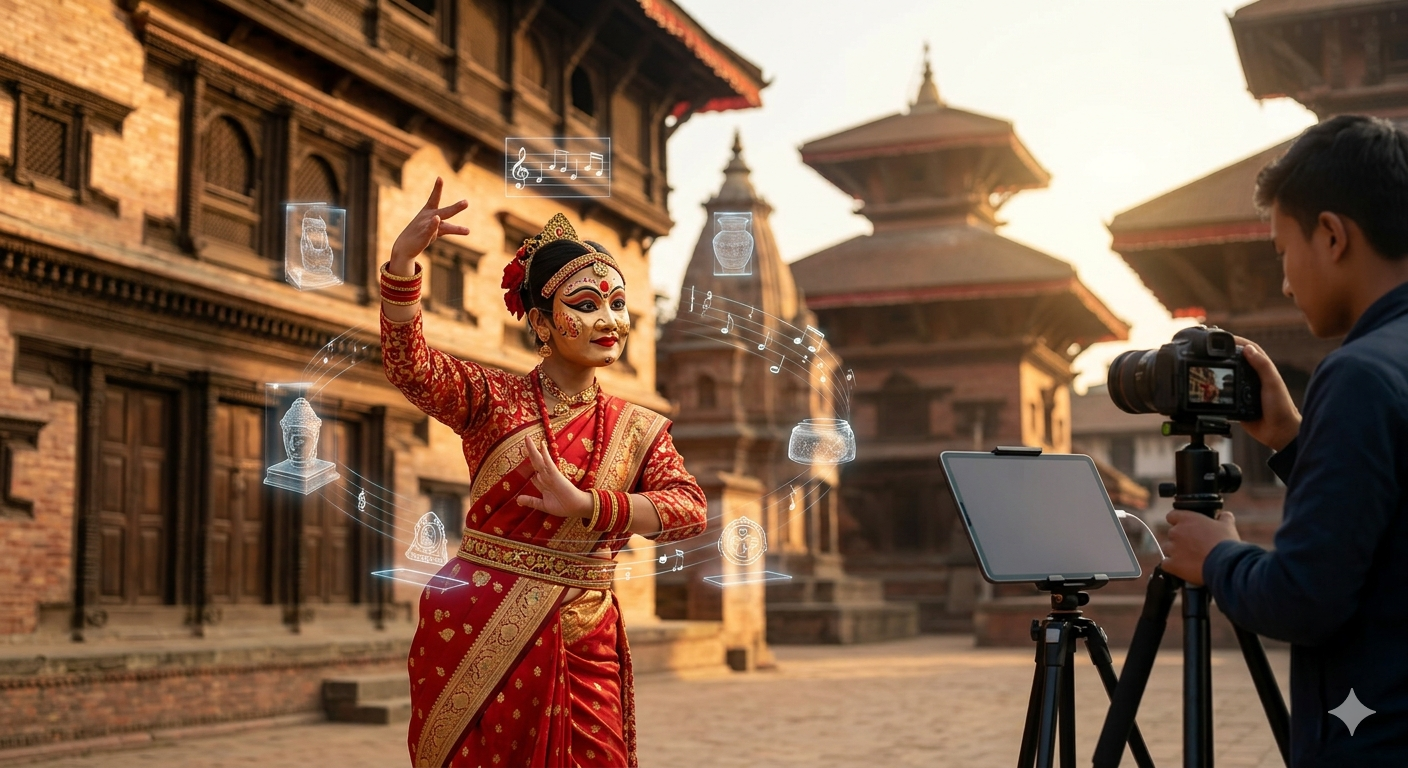
Digitization proper is turning the physical object into a digital surrogate: high-resolution photography, photogrammetry or 3D scanning for sculptures and architectural elements, flatbed scanning for manuscripts and documents, and audio or video recording for oral histories, music, and ritual performances.
Cataloguing is organizing that raw material using consistent metadata what the object is, when and where it was made, what it's made of, who it's associated with, how it relates to other objects in the collection. This is the step most institutions skip, and it's the one that determines whether the digital collection is actually usable ten years from now or just a folder of unlabeled images.
Presentation is the public-facing layer the website itself, where visitors, researchers, students, and the diaspora can actually find, view, and understand the collection.
Preservation is the ongoing part: backups, format migration as file standards change, and a maintenance plan so the digital archive doesn't quietly rot the way the paper one did.
A website project that only handles the last of these five layers is building on sand. The photography and cataloguing work has to happen first, or at least in parallel, or the "digital museum" ends up being an empty shell with a nice design.
Core Components of a Real Museum Website
A Proper Digital Collection Catalogue, Not a Photo Gallery
The single biggest difference between an amateur heritage website and a professional one is whether the collection is stored as structured data or just as images with captions.
A structured catalogue means every object in the system has consistent fields: accession number, title, category, materials, dimensions, date or period, provenance, condition, current location, associated names or communities, and a description. This is what allows a visitor to filter by "18th century, wood, Newar craftsmanship" and get a meaningful result, rather than scrolling through everything.
International metadata standards exist for exactly this purpose, and it's worth building around them from day one rather than retrofitting later:
Dublin Core a simple, widely adopted 15-element metadata standard, good for smaller collections that need to be interoperable with other digital libraries.
CIDOC-CRM (Conceptual Reference Model) the standard used by major museums internationally for describing relationships between objects, people, places, and events. More complex, but far more powerful for collections with rich historical context, which describes most of Nepal's heritage assets.
IIIF (International Image Interoperability Framework) a standard specifically for high-resolution image delivery, letting researchers zoom into a manuscript or thangka at extreme detail without the site needing to load a massive file every time.
Building the catalogue on these standards from the start means the collection can later be shared with international heritage networks, aggregated into UNESCO or ICOM databases, or cross-referenced with similar collections elsewhere none of which is possible if the data lives only as filenames like `IMG_2841.jpg`.
High-Resolution Imaging, Photogrammetry, and 3D Scanning
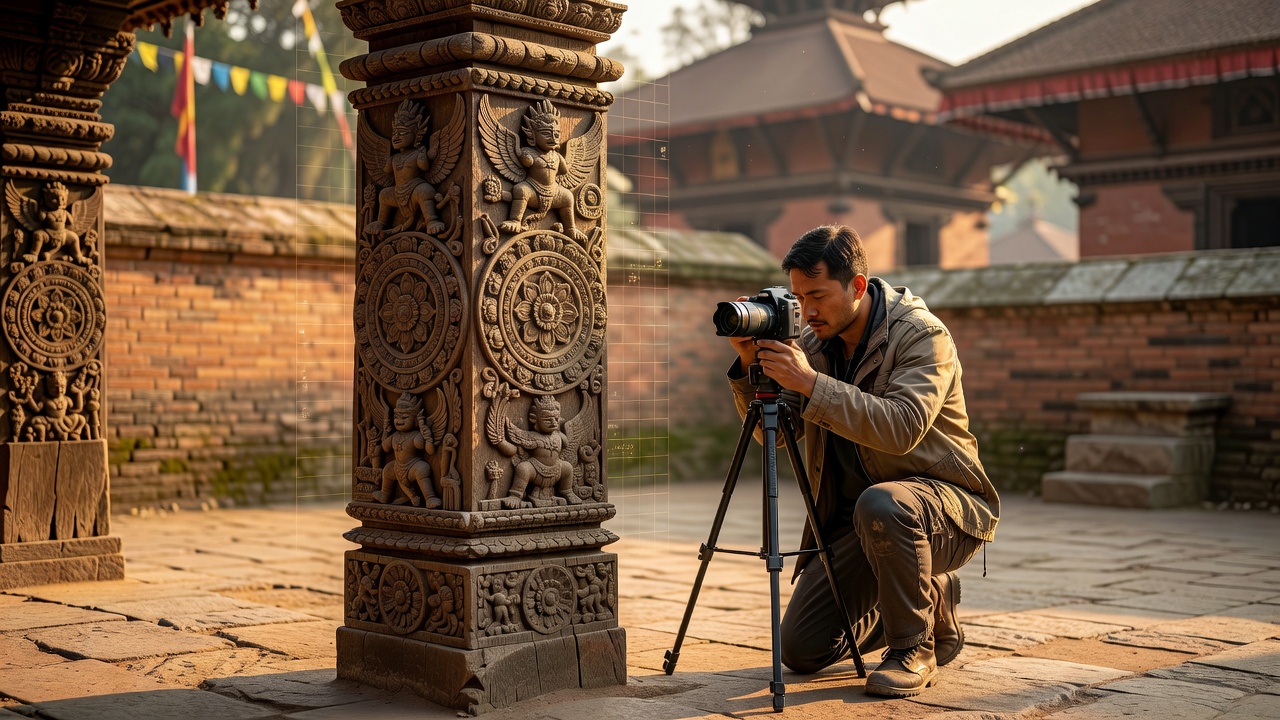
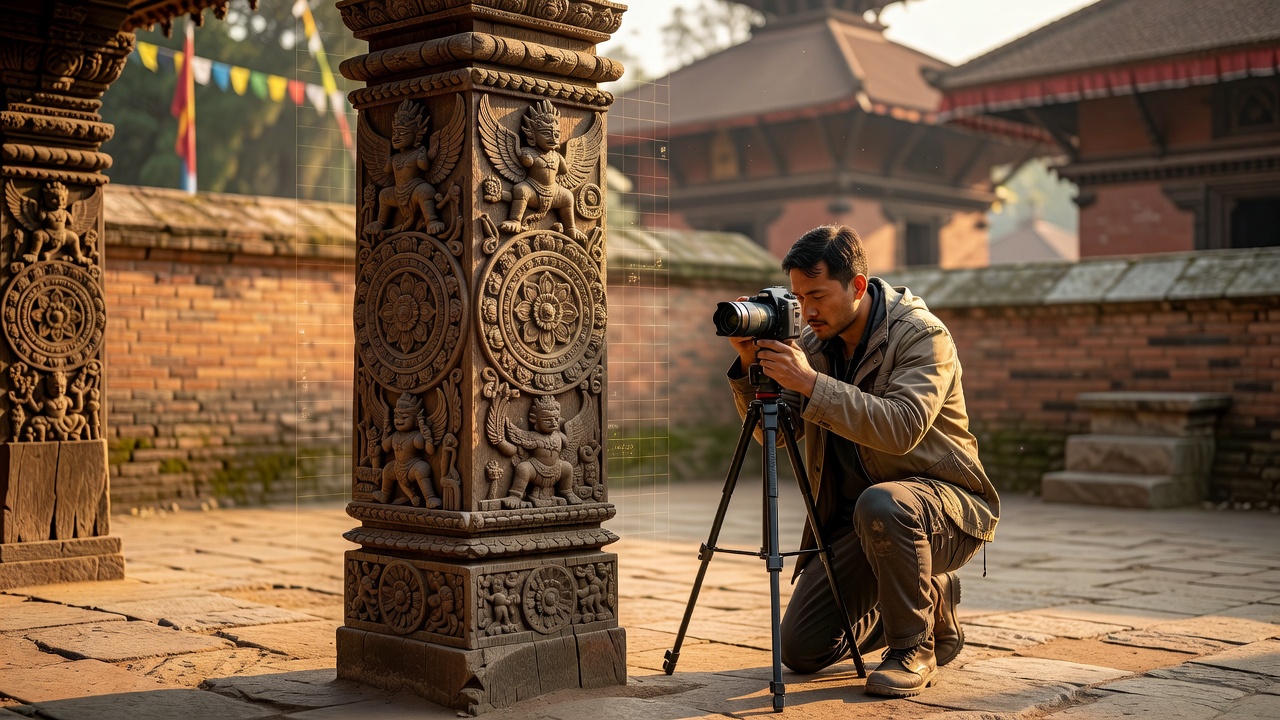
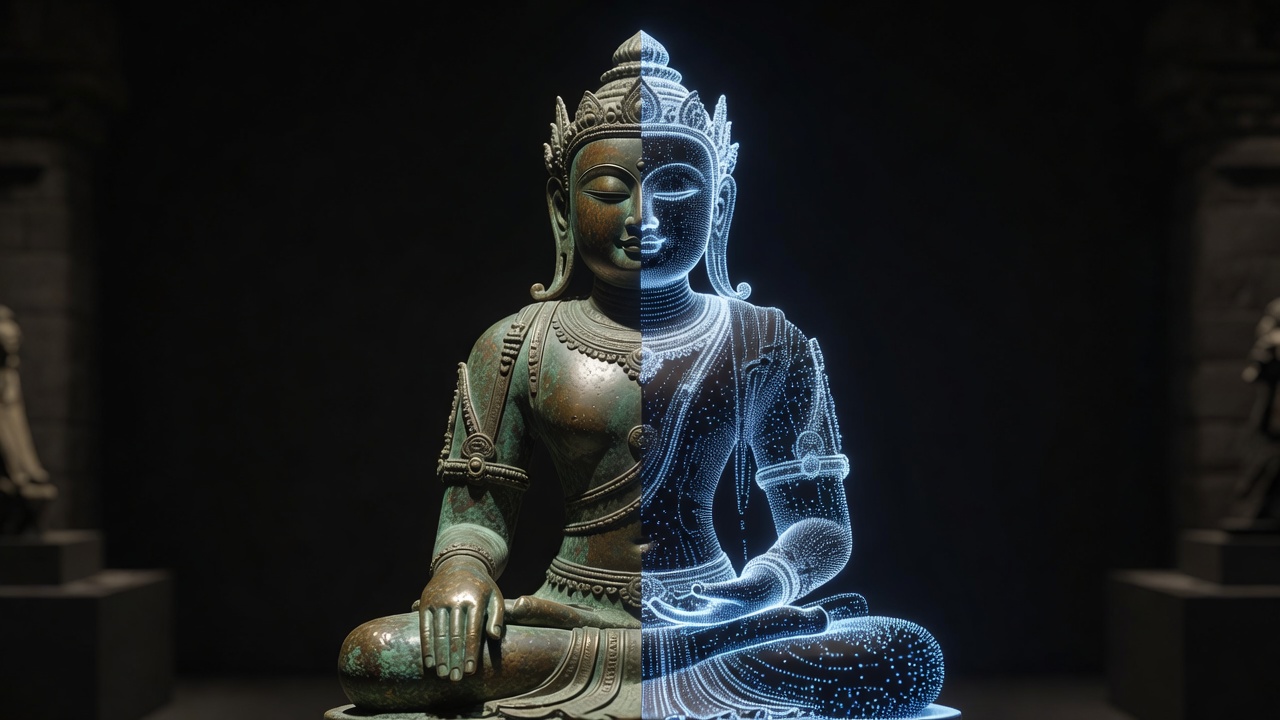
Photography is the baseline, but for three-dimensional objects statues, architectural fragments, ritual masks, pottery flat photographs lose most of the object's actual information. Photogrammetry (stitching together dozens of overlapping photographs into a 3D model using software) has become affordable enough that it no longer requires specialized scanning hardware; a good camera, consistent lighting, and the right software can produce a rotatable, measurable 3D model.
For architectural heritage specifically carved struts, temple facades, stone inscriptions this matters enormously in Nepal, because it means a damaged or lost element can be studied, measured, and even referenced for reconstruction long after the physical piece is gone. This is precisely the kind of documentation that proved invaluable after 2015, and precisely what most sites still lack today.
A website's job here is to actually host and display these models well using lightweight, browser-based 3D viewers rather than forcing visitors to download large files, and compressing models intelligently so they load reasonably even on slower Nepali internet connections outside Kathmandu.
Virtual Tours
A 360° virtual tour of a physical museum or heritage site serves two different audiences: people who cannot travel to visit in person the Nepali diaspora, researchers abroad, students and people planning a visit who want a preview. Done well, a virtual tour isn't just a panorama with hotspots; it includes narrated context, links from a viewpoint directly into the relevant catalogue entries, and multilingual narration options.
Bilingual (or Multilingual) Content by Design
This is where a lot of well-intentioned heritage sites fail. Nepali content is often added as an afterthought a language switcher that only translates the menu, while all the actual object descriptions remain in English, or vice versa.
A properly built system treats every content type object description, exhibition text, event listing, blog post as having parallel fields for each language from the database level up, not as a translation plugin bolted onto an English-first site. For a museum serving both local visitors and international researchers, and often working with communities where an object's story is best told in a specific local language or dialect, this isn't optional polish. It's core to whether the site actually communicates with its real audience.
Search and Discovery That Actually Works
A collection of a few hundred or a few thousand objects is useless if the only way to find something is to scroll. Real discovery tools include faceted search (filter by period, material, category, location, language), a timeline view for chronological browsing, a map view for geographically distributed heritage (particularly useful for a country with heritage spread across the Kathmandu Valley, Lumbini, and dozens of regional sites), and full-text search across descriptions and metadata.
Storytelling, Not Just Data
Metadata tells you what an object is. It doesn't tell you why it matters. The most effective heritage websites pair the structured catalogue with narrative content curated exhibitions, thematic collections ("Masks of the Kathmandu Valley," "Textiles of the Terai"), articles that give historical and cultural context, and video or audio features with elders, artisans, or scholars.
This is also, not coincidentally, the content that actually performs well in search engines and gets shared a well-written article about a specific tradition or object ranks and travels in a way that a bare catalogue entry never will.
Community Contribution Tools
Some of Nepal's most valuable cultural knowledge exists only in living memory. A submission system allowing community members, elders, or local historians to contribute photographs, oral histories, or corrections to existing records, subject to institutional review before publishing turns the website from a one-way broadcast into an actual archive-building tool. This is particularly valuable for intangible heritage, where the "object" being preserved is a practice, story, or skill rather than a physical artifact.
An Admin System Non-Technical Staff Can Actually Use
Museum staff are curators, historians, and conservators not developers. If adding a new object to the digital catalogue requires touching code, it simply won't happen consistently, and the site will fall out of date within months of launch. The content management system needs a straightforward interface for entering catalogue data, uploading and organizing images, managing bilingual content side by side, and publishing exhibitions and articles built around how museum staff actually think about their collection, not how a developer thinks about a database.
Accessibility
A heritage site is, by definition, meant to be for everyone — including visitors with visual, hearing, or motor impairments, and including people accessing the site on old phones over slow connections in rural areas. Reasonable accessibility (proper alt text on every image, keyboard navigation, sufficient color contrast, captions on audio and video) and reasonable performance on low bandwidth aren't optional extras; for a public heritage institution, they're closer to the point of the exercise.
Technical Architecture: Building It to Last
The technology choices matter less than most people assume a museum's digital collection will outlive any particular framework's popularity. What matters is durability, maintainability, and the ability for local developers to maintain it for decades, not just the team that built it.
A dependable architecture for this kind of project typically includes:
A relational database (MySQL or PostgreSQL) for the structured catalogue, with a schema built around established metadata standards rather than an ad-hoc set of fields
A backend built on a widely-supported, well-documented language (PHP, for instance, remains an extremely practical choice for this kind of institutional site in Nepal mature, cheap to host, and easy for future local developers to maintain without needing rare specialized skills)
A dedicated media library with automatic image optimization (serving modern formats like WebP alongside originals, so pages load fast without sacrificing the archival-quality original file)
IIIF-compliant image serving for high-resolution zoomable images, so a single upload can serve both a fast-loading thumbnail and a scholar's need to examine brushwork detail
Role-based access control, so volunteers, curators, and administrators each see only what they need to
Redundant backups, geographically separated this is not optional for a country with real seismic and climate risk. At minimum, a local backup and a cloud backup in a different region, with a genuinely tested restoration process, not just an assumption that backups exist
A disaster-recovery plan for the data itself, mirroring the physical disaster-preparedness planning museums already do for their buildings and collections
SEO and Discoverability: Making Sure the World Can Find It
A heritage site that nobody can find is barely better than a site that doesn't exist. A few things matter specifically here:
Structured data (schema.org markup) for each object, exhibition, and article helps search engines understand and surface the content properly, including in image search and knowledge panels genuinely useful for cultural content, which people frequently discover through image search first.
Clean, descriptive URLs and metadata for every page the kind of title, description, and keyword structure this very article is built around make a real difference for a niche where competition is currently low; very few Nepali cultural institutions have well-optimized digital presences, which is an opportunity as much as a gap.
A proper sitemap and consistent internal linking between the catalogue, articles, and exhibitions helps search engines index the full depth of a large collection rather than just the homepage.
Multilingual SEO, with correct language and region tagging, ensures Nepali-language content is discoverable by Nepali-speaking audiences while English content reaches the international researcher and diaspora audience separately.
Design That Respects the Subject
A heritage website's visual design carries a responsibility a typical business site doesn't: it's representing the institution's, and often the community's, identity. Generic templates and stock design patterns tend to flatten everything into the same look, which does a disservice to content this specific and this local.
Good practice here means drawing the visual language color, texture, motif from the actual heritage being presented (architectural details, textile patterns, traditional color palettes) rather than defaulting to whatever's fashionable in global web design that year; keeping performance genuinely fast, since much of the audience for Nepali heritage content is accessing it on modest connections and older devices, both within Nepal and among diaspora communities abroad; and treating photography as a first-class design element, since for a museum, the images *are* the content, not decoration around it.
Long-Term Sustainability
The hardest part of a museum digitization project usually isn't the launch it's what happens eighteen months later. A beautifully built site with no plan for ongoing maintenance becomes exactly the kind of abandoned digital asset the project was meant to prevent.
A realistic sustainability plan includes training at least two members of staff (not one institutional memory shouldn't depend on a single person) to comfortably use the admin system; a maintenance and hosting budget built into the institution's ongoing operations, not treated as a one-time project cost; a clear plan for who adds new acquisitions to the digital catalogue going forward, and on what schedule; and, where possible, partnerships with organizations like ICOM, UNESCO, or academic institutions, which can provide both technical continuity and additional funding avenues for long-term archival work.
Where to Start
For a museum, cultural organization, or community heritage group in Nepal considering this, the realistic starting point is rarely "build the whole website." It's smaller and more specific:
1. Take inventory. What exists already paper registers, old photographs, informal notes and in what condition?
2. Prioritize what's most at risk. Fragile manuscripts, oral histories held by elderly community members, and structures in poor physical condition should be documented first, before anything else.
3. Choose a metadata structure before touching any design work. This decision is far more consequential long-term than any visual choice.
4. Digitize in phases, starting with a representative subset of the collection rather than attempting everything at once.
5. Build the website around the data, not the other way around. A site designed before the cataloguing structure exists tends to need painful rework later.
This kind of project sits squarely at the intersection of cultural sensitivity, technical architecture, and long-term thinking which is exactly why it tends to go wrong when treated as a standard web development brief. It isn't one. A museum's digital collection is meant to still be readable, searchable, and meaningful in fifty years, long after the trends in web design that shaped its first version have been forgotten. Building it that way from the start is the whole point.
Bigyan Ghimire is a full-stack web developer based in Kathmandu, working on database-driven cultural heritage platforms, including ongoing digitization work with ICOM Nepal. If you're a museum, archive, or heritage organization exploring a digital preservation project, get in touch